


How Long Should You Run Your Pool Pump in Texas?
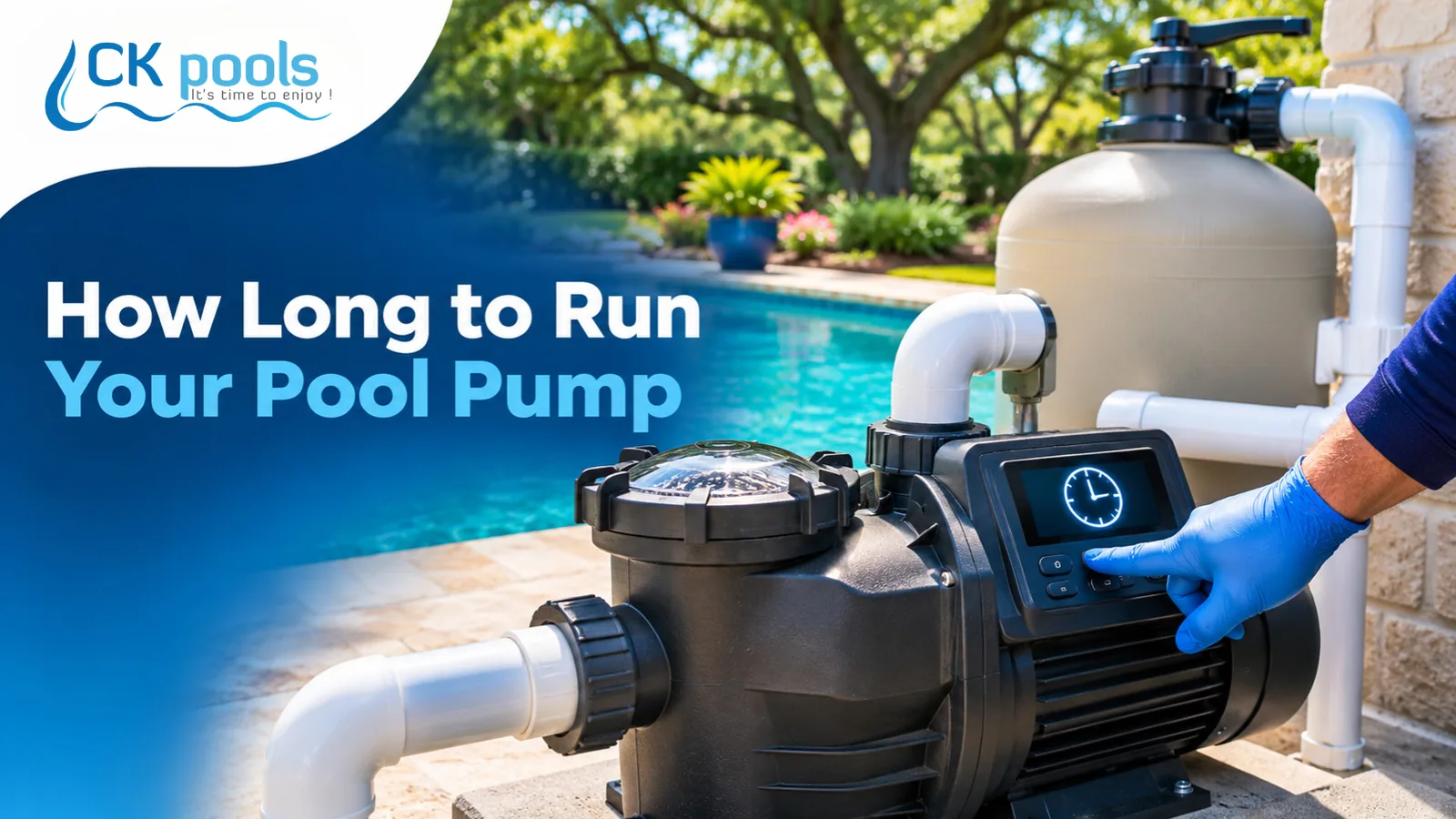
Your pool pump is the heart of your pool. It moves water through the filter, spreads chlorine, and keeps debris from settling. It is also one of the biggest energy users in many Texas homes. Run it too little and the water turns cloudy or green. Run it too much and your electric bill climbs for no reason.
Key Takeaway: Most Texas pools need about 8–12 hours of pump time per day in summer and 4–6 hours in winter. The goal is to filter the full pool volume at least once a day. Variable-speed pumps can run longer at low speed and still use far less electricity. Keep the pump running during hard freezes.
This guide explains how to figure out the right run time for your pool, the best time of day to run it, how variable-speed pumps change the math, and the freeze rules every Texas pool owner should know.
Why Pump Run Time Matters
Your pool water needs three things every day:
- Filtration to remove dirt, pollen and dead algae
- Circulation to spread chlorine to every corner
- Skimming to pull leaves and debris off the surface before they sink
Water that sits still is where algae starts. Corners, steps and areas behind ladders get the least flow, which is why green often shows up there first.
The Turnover Rule
Turnover is the time it takes for your entire pool volume to pass through the filter once. Most pools need at least one full turnover per day, and more in hot weather or heavy use.
How to calculate turnover
- Find your pool volume in gallons. A rough formula for a rectangle: length × width × average depth × 7.5.
- Find your pump flow in gallons per minute (GPM). This depends on the pump, plumbing and filter condition. A flow meter gives the most accurate number.
- Divide: pool gallons ÷ (GPM × 60) = hours per turnover.
Example
A 20,000-gallon pool with a pump moving 40 GPM:
20,000 ÷ (40 × 60) = about 8.3 hours for one turnover.
In a Texas summer, that pool should run at least 8 to 10 hours a day, often more after storms or parties.
Recommended Run Times by Season in Texas
- Summer (May–September): 8–12 hours. More after heavy rain, pool parties or algae treatment.
- Spring and fall: 6–8 hours.
- Winter: 4–6 hours, plus freeze protection on cold nights.
- Saltwater pools: enough hours for the salt cell to make the chlorine your pool needs. In summer, that often means 8–12 hours or more.
- Pools with heavy tree cover: longer run times help skimmers keep up with leaves. We see this a lot in Spring and parts of Dallas.
These are starting points. Your water tells you if they work. If the water stays clear and chlorine holds, you are close. If you see cloudiness or early algae, add time.
Best Time of Day to Run Your Pool Pump
Daytime circulation helps chlorine
The sun destroys chlorine fastest in the middle of the day. Running the pump during those hours keeps fresh chlorine moving and stops dead spots from forming.
Off-peak hours can save money
Many Texas electricity plans have cheaper rates at night or on weekends. Running part of your schedule then can cut costs.
A split schedule often works best
For example:
- 10 a.m. to 4 p.m. for circulation during peak sun
- 2–4 hours overnight on off-peak rates
Avoid running the pump only at night in summer. You will save some money but often lose more in chlorine.
Single-Speed vs. Variable-Speed Pumps
Single-speed pumps
- Always run at full speed
- Simple and lower upfront cost
- Use the most electricity per hour
Variable-speed pumps
- Let you choose low, medium and high speeds
- Low speed moves enough water for filtration while using far less power
- Quieter
- Higher upfront cost, but often pay for themselves through lower bills
With a variable-speed pump, the best approach is usually to run longer at low speed, then use a short high-speed window for skimming, vacuuming, heating or a salt cell that needs higher flow.
Some Texas utilities offer rebates on variable-speed pumps. See Texas pool pump rebates. If your pump is failing, read pool pump motor replacement cost before you buy.
Freeze Protection: A Texas Must
Texas freezes are rare but serious. When water freezes in pipes, it expands and cracks plumbing and equipment. Repairs after a hard freeze can be costly.
- Keep the pump running during hard freezes so water keeps moving.
- Use freeze protection if your automation system has it. It turns the pump on when air temperature drops.
- Check power during winter storms. If power goes out, freeze risk rises fast.
- Do not shut the pool down the way northern pools are winterized unless you plan for it properly.
Learn more in do you need to winterize your pool in Texas.
Signs Your Pump Is Not Running Long Enough
- Cloudy water that clears after longer run times
- Algae in corners, steps or behind ladders
- Chlorine that drops quickly
- Debris on the bottom by afternoon
Signs Your Pump May Have a Problem
- Low flow even with clean baskets
- Air bubbles in the pump basket
- Loud grinding or screeching
- Humming without starting
- Rising filter pressure that does not drop after cleaning
These point to issues like clogged impellers, air leaks or failing bearings. Read pool pump troubleshooting or schedule pool equipment repair and leak detection.
How Your Filter Affects Run Time
A dirty filter reduces flow, which means each hour of run time does less work. Clean or backwash the filter when pressure rises 8–10 psi above clean. Our technicians check filter pressure at every visit and log it in your report, so problems show up early. See pool filter maintenance.
How Much Does Running a Pool Pump Cost?
Cost depends on pump size, speed, hours and your electricity rate. A single-speed pump running at full power for many hours a day can be one of the largest loads in a Texas home during summer. A variable-speed pump running at low speed uses a fraction of that power for the same hours. To estimate your own cost, check the pump's watt rating or the reading on a variable-speed display, multiply by hours run, and multiply by your rate per kilowatt-hour.
Setting Your Timer or Automation
- Mechanical timers: set on and off trippers for each run window. Check them after power outages, since many lose time.
- Digital timers and automation: set schedules by season. Many let you control the pump from your phone. See smart pool automation in Texas.
- Variable-speed pumps: program different speeds for different windows, such as low speed most of the day and higher speed for an hour of skimming.
Revisit your schedule at the start of each season. Many pools still run their summer schedule in December or their winter schedule in June.
What CK Pools Checks on Every Visit
On our weekly routes, technicians check filter pressure, pump sound and flow, timer settings and chemical levels, then record it all in a digital report with photos. If we see a pump running too little for the season, we adjust it or tell you. If we hear a bearing starting to fail, you hear about it before it stops.
Why Texas Homeowners Choose CK Pools
CK Pools is a family-owned Texas pool company with 37+ years of hands-on experience and more than 4,000 completed projects. Our crews work routes in Houston, Spring, Dallas-Fort Worth, Austin, San Antonio, Baytown and Corpus Christi, so we know how coastal humidity, hard water, heavy tree cover and clay soil each affect a pool.
- Green-Free Guarantee: if your pool turns green while under our weekly care, we fix it at no extra cost.
- Digital service reports: photos and chemical readings after every visit, so you always know what was done.
- No surprise charges: we never make a repair without your approval.
- Real people on the phone: call us directly at (281) 257-6657. No outsourced call center.
Ready to hand it off? Request a free pool service quote or compare our Full and Partial Pool Service Plans.
Frequently Asked Questions
Is it OK to run a pool pump 24 hours a day?
It is safe, especially for a variable-speed pump on low speed. With a single-speed pump, running 24/7 usually wastes electricity.
Can I run my pool pump only at night?
You can, but daytime circulation helps chlorine fight the sun. A split schedule usually works best in Texas.
Why does my pool get cloudy even when the pump runs?
The filter may be dirty, chemistry may be off, or run time may still be too short for the heat and swimmer load.
Should the pump run during rain?
Yes. Rain brings debris and dilutes chlorine, so circulation helps. Make sure the pool does not overflow onto the deck.
How long should a variable-speed pump run?
Often longer than a single-speed pump, at low speed. Many Texas pools run 10–14 hours at low speed in summer.
Sources
- U.S. Department of Energy: Choosing, Installing and Operating an Efficient Swimming Pool Pump
- ENERGY STAR: Pool Pumps
About the Author
Written by the CK Pools Service Team
CK Pools is a family-owned Texas pool company with 37+ years of hands-on experience and more than 4,000 completed projects across Houston, Spring, Dallas-Fort Worth, Austin, San Antonio, Baytown and Corpus Christi. Our technicians test, clean and repair pools every week, and every article is reviewed by our field team. Questions? Call (281) 257-6657.

Most Texas pools need 8 to 12 hours of pump time per day in summer and 4 to 6 in winter, so the full volume turns over at least once a day.


