


How to Clean a Pool Salt Cell (and How Often in Texas)
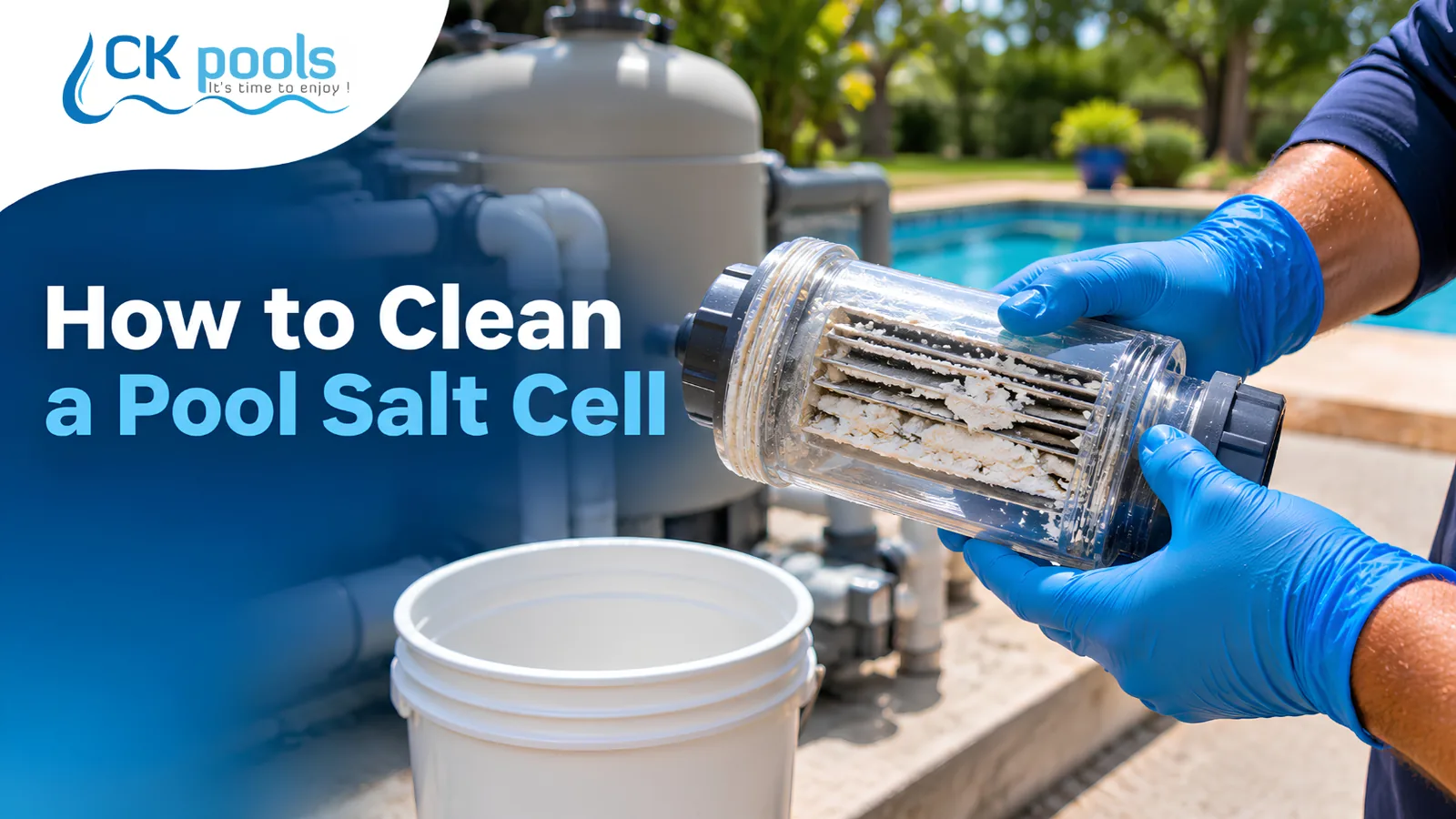
Your saltwater pool was running fine. Now the control panel says "inspect cell," chlorine readings keep dropping, and the water is starting to look dull. In most Texas pools, the cause is simple: calcium scale on the salt cell plates. The fix is just as simple once you know how.
Key Takeaway: Inspect your salt cell monthly and clean it when you see white scale between the plates, usually every 2–3 months in Texas. Turn off power, remove the cell, soak it in a mild acid solution (about 1 part muriatic acid to 4 parts water) until the fizzing stops, rinse and reinstall. Only acid clean when scale is visible.
Below, we cover how a salt cell works, why Texas water is so hard on it, a step-by-step cleaning guide, how to slow scale buildup, and when it is time to replace the cell.
How a Salt Cell Works
A saltwater pool is still a chlorine pool. Instead of adding chlorine by hand, you add salt to the water, usually around 3,000–4,000 ppm depending on your system. As water passes through the salt cell, coated titanium plates use a low electric current to turn salt into chlorine. That chlorine sanitizes the pool, then turns back into salt, and the cycle repeats.
The catch is that this same process pulls calcium out of the water and deposits it on the plates, especially on the side where the water is most alkaline. Over time, a crust forms between the plates. Less water flows over the plates, less surface area is exposed, and chlorine production drops.
Why Texas Pools Scale Salt Cells Faster
Hard water
Much of Texas has hard tap water. Austin and San Antonio sit on limestone aquifers and have some of the hardest water we service. Every top-off adds more calcium.
Evaporation
In a Texas summer, pools can lose a quarter inch of water or more per day to evaporation. Water leaves, minerals stay, and calcium climbs month after month.
High pH
Saltwater pools tend to drift toward higher pH. High pH makes calcium fall out of solution faster, right onto your cell plates.
Heat
Warm water also makes scale form faster. Peak summer is when salt cells scale the quickest, which is also when you need the most chlorine.
Signs Your Salt Cell Needs Cleaning
- White, crusty or flaky buildup between the plates
- "Inspect cell," "check cell" or "low salt" warnings even when your salt test reads correctly
- Chlorine levels falling even with output set high
- Cloudy water or early algae on steps and corners
- Reduced flow or a "no flow" error
Most cells have a clear housing or can be viewed from the end. Look straight through the cell with a flashlight. If you cannot see clean metal between the plates, it is time.
How to Clean a Salt Cell Step by Step
What you need
- Rubber gloves and eye protection
- Muriatic acid (or a cell cleaning solution from the manufacturer)
- A clean plastic bucket
- A garden hose
- A cell cleaning stand or end cap (many systems include one)
- A plastic or wooden tool for loose flakes (never metal)
Steps
- Turn off the pump and the salt system at the breaker. Do not rely on the control panel alone.
- Unplug the cell cord and unscrew the unions on both ends.
- Remove the cell and look inside.
- Rinse with a garden hose. Light scale often washes out.
- Mix the cleaning solution. Add 1 part muriatic acid to 4 parts water in a plastic bucket. Always add acid to water, never water to acid.
- Stand the cell upright in its cleaning stand or cap one end, then fill it with solution until the plates are covered.
- Let it soak until the fizzing stops, usually 10 to 15 minutes. Do not leave it for hours.
- Pour the used solution into the pool with the pump off, or neutralize it before disposal. Do not dump it in the yard.
- Rinse the cell well with fresh water.
- Reinstall the cell, hand-tighten the unions, reconnect the cord, restore power and confirm flow.
Safety tips
- Work outdoors with good airflow. Acid fumes are harsh.
- Keep pets and kids away.
- Never scrape the plates with a screwdriver or metal tool. The coating is thin and easily damaged.
- Follow your manufacturer's instructions if they differ from these steps.
How Often Should You Clean a Salt Cell in Texas?
- Inspect: monthly, and more often in summer.
- Clean: only when you see scale, usually every 2 to 3 months in hard-water areas.
- Avoid: cleaning on a fixed schedule whether it needs it or not. Every acid soak wears the plate coating a little.
How to Slow Down Scale Buildup
Keep pH in range
Aim for 7.2–7.6. Saltwater pools often need a small acid addition every week to hold pH down.
Control calcium hardness
Test calcium monthly. Most plaster pools do well around 200–400 ppm. When it climbs too high, the main fix is partial draining and refilling with softer water, or using a scale inhibitor. See our guide to lowering calcium hardness.
Use reverse polarity
Many salt systems reverse the current direction on a timer to shed scale. Make sure the feature is on and set correctly.
Do not run at 100% all summer
Running output at maximum for months speeds up wear. If you need 100% to hold chlorine, something else is usually off, such as high CYA, low salt, or a dirty filter.
Keep CYA in range
Saltwater pools typically do well with CYA around 60–80 ppm. Too little and the sun burns off chlorine. Too much and chlorine works slowly.
Other Problems That Look Like a Dirty Cell
- Low salt: test salt with a separate test strip or meter.
- Low flow: a dirty filter or clogged basket can trigger flow errors.
- Bad flow switch or sensor
- Failing control board
- Worn-out cell
If you clean the cell and the warnings continue, a technician can test the cell output and the rest of the system.
When to Replace a Salt Cell
Most salt cells last about 3 to 7 years. Lifespan depends on hours of use, output settings and water chemistry. Signs it is time:
- The cell is clean, salt is correct, and chlorine still will not hold
- Plates look thin, peeling or discolored
- The system reports low output after cleaning
- The cell has reached its rated hours
When you replace it, choose a cell sized for your pool, not the smallest one that fits. Oversized cells can run at lower output and often last longer. Weighing a switch to salt? Read saltwater pool conversion cost in Texas.
A Simple Monthly Salt System Checklist
- Look through the cell for white scale
- Test salt with a strip or meter and compare to the panel reading
- Test free chlorine, pH, alkalinity and CYA
- Check that the flow sensor and cord connections are dry and tight
- Confirm the output percentage and pump schedule still match the season
- Clean the pump basket and check filter pressure
Five minutes a month catches most problems before they cost you a cell. On our weekly routes, technicians log salt readings, cell condition and chemical levels in a digital report with photos, so owners can see when scale is starting and plan a cleaning before chlorine drops.
Salt Cell Mistakes That Shorten Its Life
- Running the system with low salt, which strains the plates
- Leaving the cell in acid for hours instead of minutes
- Ignoring high pH week after week
- Running output at 100% when the real problem is high CYA
Why Texas Homeowners Choose CK Pools
CK Pools is a family-owned Texas pool company with 37+ years of hands-on experience and more than 4,000 completed projects. Our crews work routes in Houston, Spring, Dallas-Fort Worth, Austin, San Antonio, Baytown and Corpus Christi, so we know how coastal humidity, hard water, heavy tree cover and clay soil each affect a pool.
- Green-Free Guarantee: if your pool turns green while under our weekly care, we fix it at no extra cost.
- Digital service reports: photos and chemical readings after every visit, so you always know what was done.
- No surprise charges: we never make a repair without your approval.
- Real people on the phone: call us directly at (281) 257-6657. No outsourced call center.
Ready to hand it off? Request a free pool service quote or compare our Full and Partial Pool Service Plans.
Frequently Asked Questions
Can I clean a salt cell with vinegar?
Vinegar can loosen light scale, but it is slow. For heavy Texas scale, a diluted muriatic acid soak works faster.
How often should I clean my salt cell?
Check it monthly. Most Texas pools need a cleaning every 2 to 3 months, often more in summer.
Does cleaning the cell too often damage it?
Yes. Acid wears the plate coating. Only acid clean when scale is visible.
Why does my salt system say low salt when the salt is fine?
Scale on the plates often confuses the reading. Clean the cell and retest.
How long does a salt cell last?
Typically 3 to 7 years, depending on use and water chemistry.
Sources
About the Author
Written by the CK Pools Service Team
CK Pools is a family-owned Texas pool company with 37+ years of hands-on experience and more than 4,000 completed projects across Houston, Spring, Dallas-Fort Worth, Austin, San Antonio, Baytown and Corpus Christi. Our technicians test, clean and repair pools every week, and every article is reviewed by our field team. Questions? Call (281) 257-6657.

Most salt cells in Texas need cleaning every 2 to 3 months because hard water builds calcium scale on the plates. Here is how to inspect and clean it safely.


